
Global fabric sourcing is growing, and small quality differences can become costly across large orders. Textile Exchange’s Materials Market Report 2024 estimates that worldwide fiber production reached 124 million tonnes in 2023. For buyers, that scale makes reliable material checks essential. A fabric that looks smooth under showroom lights may still shrink after washing, lose color through rubbing, or fail under tension.
Fabric Testing helps buyers compare suppliers using measurable results rather than appearance alone. Recognized methods, including ISO 105 colorfastness tests and ISO 13934 tensile tests, provide repeatable ways to assess performance. Yet a test result only reflects the sample and conditions tested. Sampling errors happen. A narrow fabric swatch may not represent an entire production batch, and laboratory results cannot remove every sourcing risk.
This guide introduces seven practical methods: fiber composition, fabric weight, tensile strength, tear resistance, dimensional stability, colorfastness, and pilling resistance. Each answers a different purchasing question. Will the fabric keep its shape? Can it withstand repeated wear? Does its color transfer during washing or rubbing? Buyers can use the answers to set specifications, compare reports, and spot issues before bulk shipment. The methods are not interchangeable, and no single pass result guarantees consistent quality. That distinction is easy to overlook. A clear testing plan, agreed before production, gives global buyers a more dependable basis for decisions.
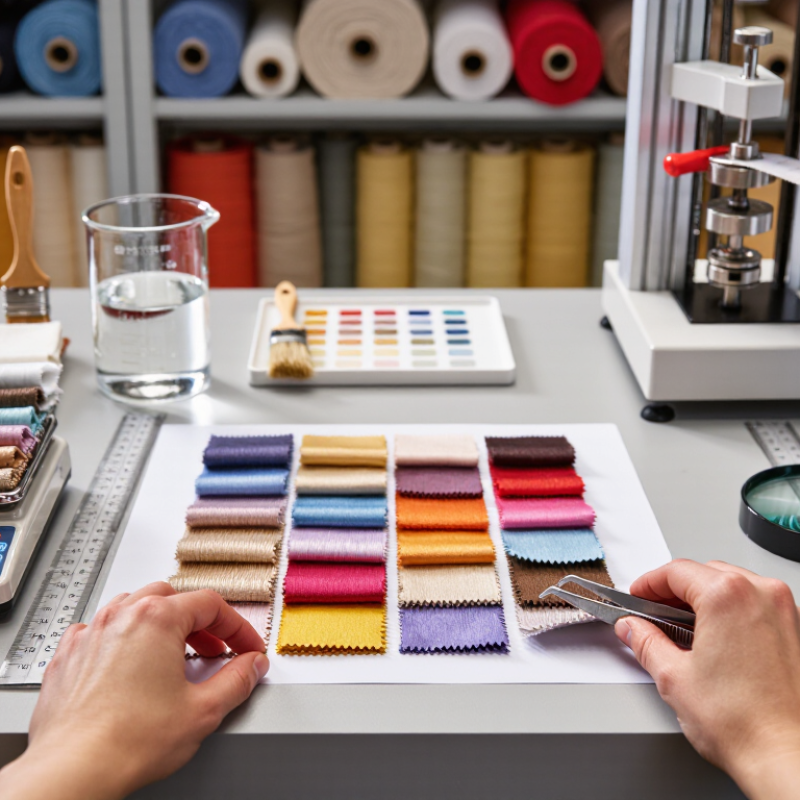
A fabric label gives a useful starting point, but testing helps buyers check what is actually in the cloth. ISO 1833 covers quantitative chemical analysis of textile fiber mixtures. It is a series of methods, not one universal procedure. The laboratory must select the method that suits the fibers being tested. Some methods separate fibers through selective dissolution, so the wrong choice can distort the result. Small details matter.
For a blend, request the fiber percentages and the specific ISO 1833 method used. Ask how the sample was prepared, especially if it contains dyes, coatings, or other finishes. These can affect analysis or require pretreatment. A clear report should identify the tested sample and explain any relevant limitations. Results are only as representative as the pieces sent to the lab.
ISO 3801 measures the mass per unit length or per unit area of woven fabric. In practice, a lab weighs measured pieces and reports the result, commonly in grams per square metre. Buyers can compare this figure with a product specification, but should confirm the sampling and conditioning details. Fabric from different roll sections may vary. Slight differences are normal; unexplained variation deserves a closer look. Don’t judge quality by weight alone: construction and intended use also matter.
For global fabric sourcing, tensile and tear tests answer different questions. ISO 13934-1 measures maximum force and elongation using a fabric strip pulled at a controlled rate. Test warp and weft directions separately; a material may resist lengthwise loading but stretch or fail across its width. Record specimen dimensions, conditioning, and test direction for fair comparisons between production lots.
ISO 13937-2 measures tear force with a trouser-shaped specimen. A pre-cut slit creates two legs, which are pulled apart to propagate the tear. The result helps buyers assess how a small cut might continue under load. It does not, by itself, predict garment durability. Fabric construction, finishing, and sample variation can affect results. A tidy report can still hide an unrepresentative sample.
Tips: Ask the laboratory to state the test method, direction, conditioning, and number of specimens. Compare like with like. If results vary sharply, review sampling and repeat testing before accepting the figures.
Among the seven best fabric testing methods for global buyers, ISO 105-C06 washing colorfastness deserves close attention. The test exposes a dyed specimen to controlled laundering, then assesses color change and staining on adjacent fabric. Ratings use a 1–5 grey scale: 1 indicates severe change, while 5 indicates negligible change. Ask the laboratory to report both assessments, not just a pass or fail. Small details matter. Specify the ISO 105-C06 test option, wash temperature, detergent, and number of cycles before comparing suppliers. Different settings can produce unlike results.
Textile Exchange reported 124 million tonnes of global fiber production in 2023 in its 2024 Materials Market Report. At that scale, consistent test records help buyers compare fabric lots and flag unstable shades before bulk cutting. Keep the wash conditions, original specimen, and grey-scale results together in the inspection file. Yet a strong laboratory score is not a promise of identical home-laundry results. Machines, water hardness, and repeated washing vary. Treat borderline scores as a reason to review or retest the fabric, rather than as automatic reassurance. That can be inconvenient.
Dimensional change can turn a well-fitting garment into a poor fit after one wash. ISO 5077:2007 specifies how to measure changes in textile dimensions after washing and drying. ISO 6330:2021 sets out domestic washing and drying procedures for textile testing. Together, they help buyers compare fabric samples under controlled conditions. Mark measured distances on the fabric, record them before washing, then measure again after the specified cycle. A 2% change across a 60-centimeter panel equals 1.2 centimeters—enough to affect a hem or side seam.
The scale of production makes this check practical, not fussy. Textile Exchange’s Materials Market Report 2024 estimated global fiber production at 124 million tonnes in 2023. That figure does not predict shrinkage, but it shows why consistent testing matters across large supply chains. Specify the wash program, drying method, detergent, and number of cycles in the test request. Small differences matter. A result from line drying may not match one from tumble drying. One weakness remains: laboratory results cannot capture every household’s habits.
Tips: Measure in both length and width, and keep the marked points consistent. Record the fabric’s conditioning conditions and use the same test settings for repeat checks. Agree on acceptable limits before production; there is no single pass mark for every product. A rushed comparison can mislead.
A fabric can look smooth on a sample card and still pill after repeated rubbing. ISO 12945-2:2020 uses a modified Martindale method to assess surface pilling, fuzzing, or matting. After the agreed rubbing cycles, trained assessors compare the specimen with reference images.
For buyers, record the fabric construction, test cycles, conditioning, and rating together. A grade without those details can be misleading. Keep lighting and viewing conditions consistent, and compare samples from the same production lot where possible.
Textile Exchange’s Materials Market Report 2024 estimates global fiber production reached 124 million tonnes in 2023. That scale makes clear, repeatable quality checks valuable across complex supply chains, though the figure does not measure pilling performance.
One score is not the whole story. Pilling in daily wear also depends on fabric use, care, and friction points such as cuffs or seat areas.
The test is a controlled comparison, not a perfect forecast; buyers should treat borderline ratings with care.