How to Choose Fluted Coupe Glasses for Your Business?
Choosing Fluted Coupe Glasses for a business means balancing presentation with everyday practicality. Their ridged bowls catch the light and give cocktails, sparkling wine, and carefully layered desserts a distinctive look. But a striking glass still needs to feel comfortable in the hand. Looks matter.
Consider where the glasses will be used. A lively bar may need sturdy, easy-to-store options, while a hotel lounge may favor a finer profile for slower service. Check capacity, rim shape, stem length, base stability, and how the glass feels when filled. A coupe that looks elegant on a shelf can feel top-heavy during a busy shift. Test them first.
Cleaning and replacement deserve equal attention. Ask suppliers about glass thickness, care instructions, case quantities, and the availability of matching replacements. If your team uses commercial dishwashers, confirm that the recommended care suits your equipment rather than assuming every glass can handle the same routine. Compare samples under your actual lighting, with your usual drinks, and after washing. Small details show up quickly.
Price alone rarely tells the whole story. A lower unit cost may be offset by frequent breakage, awkward storage, or inconsistent stock. Still, durability claims can be difficult to judge from a product page, so sample testing matters. This guide explains how to assess Fluted Coupe Glasses for your venue, compare useful features, and choose a style that supports service as well as presentation. There may be no perfect choice; the right fit depends on your menu, staff, storage, and budget.
Understanding the Role of Fluted Coupe Glasses in Your Business
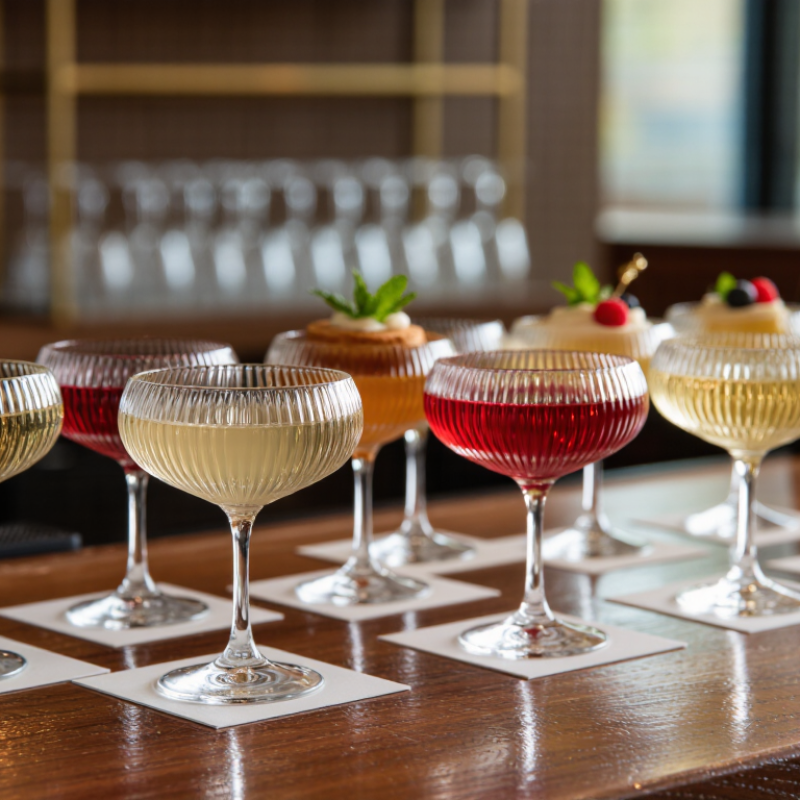
Fluted coupe glasses do more than hold cocktails. Their ridged bowls catch light, while the wide rim makes garnishes and aromas easy to notice. In a hotel lounge or restaurant, that visual detail can help define the drink’s presentation. It also needs to work during a busy shift. A glass that looks elegant but feels awkward is not a useful choice.
The National Restaurant Association’s 2024 State of the Restaurant Industry report projected U.S. restaurant sales of $1.1 trillion and employment of 15.7 million. Those figures describe a competitive, high-volume sector, not proof that decorative glassware increases sales. Still, service details matter. Check the glass’s capacity against actual recipes, and test its weight with a full pour. A thick stem may feel sturdy, but it can change the balance.
Small details matter. Ask staff to carry a tray of filled glasses, then wash and stack a sample batch. Look for ridges that trap residue, rims that chip easily, and bowls that wobble on crowded tables. I would not choose from photographs alone; lighting can make fluting appear deeper than it is. Test them first. Compare replacement availability, storage space, and breakage costs before ordering for the whole venue.
Identifying Service Needs, Drink Types, and Customer Expectations
How to Choose Fluted Coupe Glasses for Your Business?
Match the glass to your service pace and menu. A shallow, fluted bowl suits sparkling cocktails and short, spirit-forward drinks, while a larger bowl gives room for crushed ice or a garnish. Check the capacity against your standard pours; an oversized coupe can make a modest serving look sparse. The stem keeps hands away from chilled bowls, but it can slow handling during a crowded service. Test a sample during a real shift.
Tips: Check that the base sits steadily on your trays and shelves. Confirm the glasses fit your dishwasher racks, and ask staff to handle a few before ordering in volume.
Customer expectations matter, too. Guests may value the elegant silhouette, but they also expect a comfortable, clean glass with no visible chips or water spots. Fluted sides catch light nicely, though narrow grooves can take extra attention during washing and inspection. That trade-off is easy to underestimate. Compare breakage, replacement availability, and storage space alongside appearance. If your menu changes often, choose a versatile size rather than buying several shapes at once. Small details matter. A quick trial with your bartenders and servers can reveal awkward pouring, unstable trays, or a rim that feels too delicate.
Comparing Glass Materials, Capacity, Shape, and Design
For a busy bar, glass material affects both presentation and replacement costs. Soda-lime glass is widely used and often suits frequent service, but check its stated resistance to chips and temperature changes. Crystal-style glass can offer extra clarity and a finer rim; it may need gentler handling. Specifications differ by supplier. Ask for sample glasses and test them in your own washing routine before ordering.
Capacity should match the drink, not just the shelf space. A 180–240 ml coupe can leave room for a cocktail’s garnish and foam, while larger bowls may suit sparkling wine pours. Measure your standard serving and leave visible headspace. A glass filled to the rim looks awkward. Small details matter.
The coupe’s broad bowl displays color and aroma, while its stem keeps hands away from the drink. Fluted sides add texture and catch light under a bar’s warm lamps, though deep grooves can take longer to clean and dry. Check how the base sits on your trays and whether the rim feels comfortable during service. A dramatic shape may photograph well but stack poorly. That trade-off is easy to miss in a catalog; test a small quantity with staff before committing.
Evaluating Durability, Safety, and Ease of Maintenance
For a busy bar or restaurant, fluted coupe glasses must handle repeated washing, fast service, and occasional knocks. Ask suppliers for documented breakage or thermal-shock test results, not just claims of “commercial quality.” ASTM C149 describes a test method for thermal shock resistance in glass containers; it can help buyers compare evidence, though it does not guarantee that every glass will survive every dishwasher cycle. Check the rim and stem carefully. Small chips can hide between the flutes. A beautiful glass can still be impractical.
Safety depends on more than appearance. The FDA Food Code 2022 specifies hot-water immersion sanitizing at 77°C (171°F) for at least 30 seconds. Confirm that your washing process follows applicable equipment instructions and local requirements, and ask whether the glassware is suitable for your machine’s temperatures. Fluted grooves can hold lipstick, syrup, or detergent residue, so inspect them under bright light and test cleaning with your actual racks. Try a small batch first. Staff feedback matters. One awkward shape can slow service.
For easier maintenance, favor evenly spaced flutes, a stable foot, and a rim that is easy to inspect and polish. Leave enough rack space to prevent glass-on-glass contact, and avoid stacking unless the supplier explicitly permits it. Record chips and breakages during a trial period; the pattern may reveal a poor rack fit rather than weak glass. There is no perfect coupe. A slightly heavier glass may feel secure, yet tire staff during long shifts. Weigh both trade-offs before ordering.
How to Choose Fluted Coupe Glasses for Your Business? — Evaluating Durability, Safety, and Ease of Maintenance
| Glass Type | Practical Capacity | Durability Considerations | Food-Contact Safety | Maintenance and Service | Business Suitability |
| Standard soda-lime glass | 180–240 mL (about 6–8 US fl oz) is a useful range to consider for a coupe serving. | Common and economical, but vulnerable to impact and sudden temperature changes. Fluted detailing can make chips or cracks harder to notice during quick checks. | Choose glassware intended for food and beverage use. Inspect rims and bowls regularly; remove chipped or cracked pieces from service. | Use a dishwasher only when the supplier identifies the glass as dishwasher-safe. Avoid abrupt temperature changes and abrasive cleaning materials. | A practical choice where replacement cost and appearance are balanced with careful handling. |
| Tempered soda-lime glass | 180–240 mL (about 6–8 US fl oz); confirm the usable fill volume for the selected shape. | Heat treatment improves resistance to mechanical and thermal stress compared with otherwise similar non-tempered glass. It is not unbreakable; a break can cause the glass to fragment. | Verify that the product is made for food contact and obtain the supplier’s care and breakage guidance. Discard any damaged glass. | Dishwasher suitability depends on the product and washing conditions. Follow the supplier’s instructions rather than assuming all tempered glass is dishwasher-safe. | Worth evaluating for busy service where reduced breakage risk is a priority, provided handling and washing procedures are followed. |
| Borosilicate glass | 180–240 mL (about 6–8 US fl oz) is a suitable comparison range; available coupe designs and capacities vary. | Its lower thermal expansion makes it more resistant to thermal shock than ordinary soda-lime glass. This does not necessarily make it more resistant to impact. | Confirm food-contact suitability and follow the maker’s instructions. Thermal-shock resistance does not mean the glass cannot break. | Check the specific product’s dishwasher guidance. Prevent knocks against sinks, racks, and other glassware during loading and unloading. | Consider when temperature changes are a concern; compare availability, replacement cost, and impact performance before ordering. |
| Lead-free crystal glass | 180–240 mL (about 6–8 US fl oz) is a practical range for comparing serving size and presentation. | Often selected for clarity and refined appearance, but durability varies by composition and construction. A thinner rim or bowl may require more careful handling. | Specify lead-free glass intended for food and beverage use. Request applicable food-contact compliance information from the supplier. | Do not assume it is dishwasher-safe. Follow product-specific instructions; hand-washing may be recommended for delicate designs or finishes. | Best evaluated for presentation-focused service where staff can support careful handling and any additional care requirements. |
Purchasing check: Capacity figures are comparison ranges, not guaranteed specifications. Before ordering, request the exact capacity, glass dimensions, weight, dishwasher-care instructions, food-contact documentation, and replacement availability. Test samples in your glass racks and commercial dishwasher before committing to a large order.
Assessing Suppliers, Pricing, and Long-Term Value
When comparing suppliers, look beyond the quoted price per glass. Calculate landed cost, including freight, packaging, expected breakage, and replacement orders. Ask for samples from the production run, not just a polished display sample. Check the rim for smoothness, the stem-to-bowl joint for wobble, and the fluting for consistent depth. Test washing and storage in your own operation. Can staff handle them quickly? Do they fit your racks? Small tests help.
Request written details on minimum order quantities, lead times, defect claims, and whether the same design will remain available. A low-cost glass can become expensive if replacements arrive late or differ visibly from the original batch. The U.S. Environmental Protection Agency’s 2018 Advancing Sustainable Materials Management report estimated that 1.0 million tons of glass containers were recycled from 3.1 million tons generated, a 31.3% recycling rate. That figure describes containers broadly, not coupe glasses specifically. Still, it supports asking suppliers about recycled content and local recovery options. A neat spreadsheet can miss awkward details, like a flute pattern that traps water spots. I would compare total cost per usable glass over a year, then revisit the estimate after real service.
How to Choose Fluted Coupe Glasses for Your Business
Example procurement weighting for comparing suppliers, pricing, and long-term value. Adjust the percentages to match your business priorities.
Use the same criteria for every supplier. Compare unit price alongside glass quality, delivery reliability, order flexibility, packaging, and after-sales support to assess overall value.