Top 10 Benefits of Cold Rolled Coil for Manufacturing Applications?
Cold Rolled Coil (CRC) has become essential in various manufacturing sectors. Its popularity derives from its superior surface quality and dimensional accuracy. According to the World Steel Association, cold-rolled steel accounts for nearly 50% of the global market for flat products. This significant share highlights its critical role in automotive and appliance manufacturing.
Using Cold Rolled Coil, manufacturers achieve lower production costs. Advances in technology improve efficiency in coil processing. For instance, CRC provides better formability, which is crucial for complex shapes in automotive parts. However, many manufacturers still underutilize the full potential of CRC, leading to higher rejection rates.
The benefits of Cold Rolled Coil also extend to sustainability. Organizations report lower energy consumption during production. However, it's vital to assess the long-term impact of CRC usage. Striking a balance between efficiency and environmental responsibility remains a challenge for many companies in the industry.
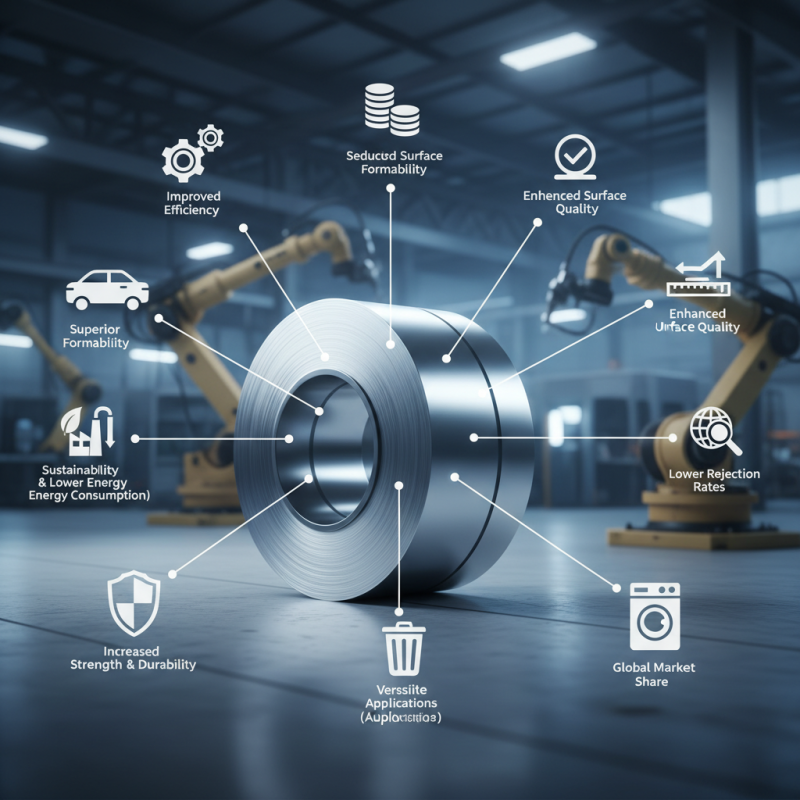
Benefits of Cold Rolled Coil in Precision Manufacturing Applications
Cold rolled coil is widely used in precision manufacturing applications. Its smooth surface finish allows for better paint adhesion. Additionally, it provides enhanced formability for complex shapes. This makes it an ideal choice for products requiring high precision. Manufacturers often favor cold rolled coils due to their tight tolerances. This leads to improved product quality and consistency.
When working with cold rolled coils, it’s essential to consider the thickness. Thinner materials may be more flexible but can also be prone to damage. Evaluate your specific application needs carefully. It’s a good practice to run tests with various thicknesses. This can help determine the optimal material for your requirements.
Another aspect to consider is the mechanical properties. Cold rolled coils can have varied tensile strengths. Assessing the strength requirements for your project is critical. Some coils might appear perfect but aren’t suitable for high-stress applications. Testing and validating each batch will provide better outcomes. Quality control in manufacturing is vital for maintaining performance standards.
Top 10 Benefits of Cold Rolled Coil for Manufacturing Applications
This chart illustrates the top 10 benefits of using cold rolled coil in precision manufacturing applications, showcasing its advantages such as improved surface finish, tighter tolerances, and enhanced mechanical properties.
Enhanced Surface Finish and Dimensional Accuracy in Cold Rolled Products
Cold rolled coil (CRC) has become a crucial material for modern manufacturing. One of its standout features is the enhanced surface finish it provides. This surface quality is important for applications that require aesthetics and functionality. A smooth surface reduces friction and improves the lifespan of components. However, achieving a flawless finish depends on the precision during manufacturing.
Another significant benefit is dimensional accuracy. Cold rolling allows for tighter tolerances, which is vital for components that must fit together seamlessly. Manufacturers can produce parts with minimal deviation from specified dimensions. Yet, this precision can sometimes come at the cost of flexibility. Processes can be rigid, potentially leading to issues if adjustments are needed during production.
The combination of superior surface quality and high dimensional accuracy has made CRC a preferred choice in various industries. However, as with all manufacturing processes, continuous evaluation is necessary. Addressing imperfections in the production process remains a challenge. Finding the right balance between quality and efficiency is not always easy but is essential.
Cost-Effectiveness of Cold Rolled Coil in Mass Production Scenarios
Cold rolled coil (CRC) is a vital component in manufacturing. Its cost-effectiveness stands out, especially in mass production. The process of cold rolling leads to thinner, stronger sheets. This creates more material from less, saving costs significantly for manufacturers. When producing large volumes, these savings multiply.
The advantage isn't just in raw materials. CRC also requires less energy for production. Manufacturers can streamline operations more effectively. However, it’s crucial to monitor the production process carefully. Any misalignment can lead to costly defects. Small errors in handling CRC can propagate, leading to bigger issues later. Finding a balance between efficiency and quality control becomes essential.
Additionally, CRC offers flexibility in design. It works well for various applications, allowing for easy adjustments. However, some manufacturers may struggle to adapt to changing specifications. The initial investment might seem daunting. Yet, in the long-run, cold rolled coil proves to be a smart choice for many. Regular evaluations and adjustments are necessary to maximize these benefits.
Strength and Durability Advantages of Cold Rolled Steel Over Hot Rolled
Cold rolled steel offers several strength and durability advantages over hot rolled steel. For starters, it has a higher yield strength, which means it can withstand larger forces without deforming. This strength makes it ideal for critical structural applications. With precise dimensions, cold rolled coils provide tight tolerances that enhance the quality of manufactured products.
Another notable feature is its surface finish. Cold rolled steel often has a smoother surface compared to hot rolled steel. This smoothness allows for better paint adhesion and surface treatments. However, it also makes cold rolled steel susceptible to corrosion if not properly protected. Galvanization or painting can mitigate this risk, but some manufacturers overlook this essential step.
Despite its advantages, cold rolled steel can be less ductile than its hot rolled counterpart. This can lead to challenges during forming processes. Moreover, the extra processing can increase production costs. This consideration might push some manufacturers to reconsider their choices carefully. Balancing strength, cost, and application requirements is key in making the best decision.
Wide Range of Applications Across Industries Utilizing Cold Rolled Coils
Cold rolled coil (CRC) has transformed various manufacturing sectors. Its versatility stands out across industries, from automotive to appliances. In the automotive sector, CRC is used for car frames and body panels. It offers strength and durability, essential for safety.
In the appliance industry, cold rolled coils are pivotal for items such as refrigerators and washing machines. The smooth surface finish allows for attractive designs. This adaptability helps manufacturers keep up with consumer trends. However, using CRC comes with challenges. Ensuring uniform thickness and surface quality can be difficult. Manufacturers often need to refine processes to achieve optimal results.
Additionally, CRC is utilized in construction and metal furniture production. It provides the necessary structural integrity for steel beams and supports. But not every supplier offers the same quality. This inconsistency can lead to case-by-case issues. Continuous improvement in sourcing and production techniques is vital for success. Though cold rolled coil presents many benefits, manufacturers must navigate its complexities thoughtfully.