
China is a major sourcing destination for connected entry systems, including the Cloud Video Door Phone. Manufacturers offer products for apartments, villas, offices, and multi-unit buildings. Yet a polished product photo cannot show how well a system performs at a doorway. Buyers should examine the device, software, and support together.
Useful checks include camera resolution, night visibility, two-way audio, app response time, and compatibility with existing locks or indoor monitors. Ask for clear specifications and a live demonstration. Watch how quickly the screen shows a visitor, whether speech remains clear near a busy street, and what happens when the internet connection drops. Small details matter. A delayed alert can frustrate residents.
When comparing Chinese manufacturers, review their production experience, quality-control process, warranty terms, and ability to provide firmware updates. Request relevant test documents, but confirm their scope and date rather than relying on a badge alone. Also clarify customization costs, minimum order quantities, and spare-part availability before placing an order. Some product pages leave these points vague. That deserves a follow-up question. The best supplier is not always the one with the lowest quote; dependable communication and consistent samples are practical signs of a stronger partnership. Still, no checklist replaces testing the system in the building where it will be used. This guide introduces manufacturers and evaluation criteria to help buyers make a more informed comparison.
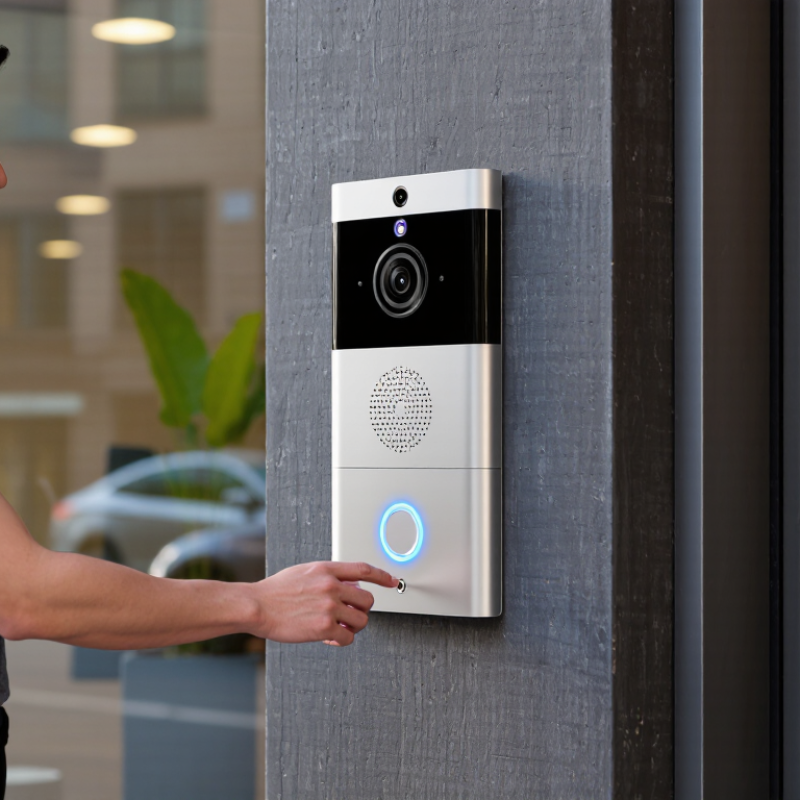
A cloud video door phone is an internet-connected entry system that lets residents see and speak with visitors remotely. An outdoor camera and call button send a live video and audio feed to an indoor monitor or mobile app. Depending on the model, cloud services may route calls, store clips, and keep event records. Some systems can also signal a compatible door lock, though the phone itself does not guarantee secure entry.
Cloud connection changes daily use. A resident away from home can answer a courier, while a night-time visitor appears on screen with a timestamp. Gartner’s November 2023 forecast put worldwide public-cloud end-user spending at $679 billion in 2024, up 20.4% from 2023. That figure describes broad cloud adoption, not door-phone sales, but it shows the infrastructure behind remote services is expanding. The weak point? Network dependence. A slow Wi-Fi signal can delay a call, and cloud features may stop during an outage. Buyers should check local recording options, account security, retention settings, and whether basic doorbell functions still work offline. The details matter.
A cloud video door phone connects an entrance unit to a household network and a remote service. The unit usually contains a camera, microphone, speaker, call button, and door-release connection. When a visitor presses the button, the device sends an alert through the internet to the resident’s phone. A live video stream and two-way audio let them see and speak with the visitor.
The cloud service helps route calls when the resident is away from home. Depending on the system, it may also store clips or manage user permissions. The resident can approve an entry request in the app, which sends a command back to the door unit. The door-release relay then operates the compatible lock. It sounds simple. Network quality still matters: weak Wi-Fi can cause delayed alerts, choppy video, or dropped audio. Installers should test the signal at the entrance, not just beside the router. They should also check what happens during an internet outage and whether recordings remain available. Cloud access is useful, but it is not magic; setup details deserve careful review.
China’s cloud video door phone manufacturers compete through practical engineering: clear night images, quick two-way audio, stable Wi-Fi, and responsive mobile alerts. At production lines, surface-mount assembly, camera alignment, burn-in testing, and repeated call-and-unlock cycles help expose faults before shipping. Small details matter.
Grand View Research valued the global video doorbell market at US$2.28 billion in 2023 and forecast 12.5% annual growth through 2030. This is an adjacent category, not a direct measure of door-phone demand. IoT Analytics’ State of IoT report estimated 18.8 billion connected devices worldwide by the end of 2024, highlighting the importance of dependable network performance. Good hardware is only part of the job.
Manufacturers should verify video quality under dim hallway lighting and test audio through closed doors. Cloud functions need clear retention settings, secure data transmission, and dependable firmware updates. Buyers can request test records for temperature, vibration, network recovery, and long-duration operation. Ask how devices behave when Wi-Fi drops. That answer matters. A weakness worth checking: factory tests may not reflect real buildings, where thick walls and crowded networks can disrupt calls. Testing across varied conditions gives a more useful picture of manufacturing capability.
| Capability Area | Typical Features or Benchmarks | What to Verify with a Manufacturer |
|---|---|---|
| Indoor Monitor | Common screen sizes include 4.3, 7, and 10.1 inches. Touchscreen options, hands-free communication, and multi-monitor configurations are widely available. | Confirm screen resolution, operating system, user interface languages, mounting method, and compatibility with the outdoor station. |
| Outdoor Video Station | Configurations commonly include a wide-angle camera, microphone, speaker, call button, and infrared illumination for low-light use. Full HD (1920 × 1080) is a common camera resolution option. | Check camera resolution and field of view, night-vision performance, audio quality, and whether the unit supports one or multiple apartments. |
| Network and Cloud Connectivity | Depending on the system, connectivity may use Ethernet, Wi-Fi, or Power over Ethernet (PoE). Cloud-connected models can support app notifications, remote answering, and visitor video calls. | Ask which Wi-Fi bands are supported, whether PoE is available, how remote access is secured, and whether cloud services require a subscription. |
| Protocols and Integration | Some products offer SIP-based communication or integration with third-party access-control and building systems. Protocol support varies by model and software version. | Request the protocol documentation, supported APIs, integration test results, and confirmation of compatibility with the intended system. |
| Access-Control Functions | Depending on the configuration, access methods may include an electric-lock relay, PIN entry, or RFID credentials. RFID systems may use 125 kHz or 13.56 MHz technologies. | Verify the credential technology, relay rating, lock compatibility, emergency-release behavior, and any local access-control requirements. |
| Weather and Vandal Resistance | Outdoor models may be offered with an IP65-rated enclosure, indicating dust-tight construction and protection against water jets under the specified test conditions. Ratings depend on the tested product configuration. | Request the test report for the complete assembled unit and check operating-temperature limits, materials, seals, and any impact-resistance rating. |
| Electronics Manufacturing | Typical production processes can include PCB assembly, surface-mount technology (SMT), solder-paste inspection, automated optical inspection (AOI), and final product assembly. | Ask which processes are performed in-house, how component traceability is maintained, and whether inspection records can be provided for production batches. |
| Quality and Reliability Testing | Relevant checks may include call and unlock function tests, audio/video tests, network connection checks, power-on aging, and inspection of enclosure sealing. | Confirm test coverage, sampling or 100% inspection practices, aging-test duration, failure tracking, warranty terms, and corrective-action procedures. |
| Compliance and Documentation | Market access may require applicable electrical-safety, electromagnetic-compatibility, radio, and substance-restriction documentation. Requirements depend on the destination market and product configuration. | Request current certificates and test reports that identify the exact model, radio modules, and manufacturing site; verify that they cover the target market. |
| Customization and OEM/ODM Support | Common customization options include enclosure color, logo placement, language, boot screen, user interface, packaging, and selected hardware configurations. | Clarify tooling costs, minimum order quantities, sample lead time, engineering-change control, ownership of custom designs, and production lead times. |
Specifications and capabilities vary by model and supplier. Treat the benchmarks above as comparison points, and verify product-specific claims with technical documents and sample testing.
Leading Chinese Cloud Video Door Phone Manufacturers
Chinese cloud video door phone manufacturers supply connected entry systems for homes, apartments, and commercial buildings. A typical setup includes an outdoor camera panel, an indoor monitor, a mobile app, and cloud services. Compare the complete system, not just the product catalog. Ask how video quality holds up in dim corridors, whether calls remain clear on a weak Wi-Fi signal, and how updates are managed. Small details matter.
Tips: Request a working sample, installation instructions, and written specifications. Test the door call, two-way audio, night image, and app notifications on your own network. Confirm which functions need an ongoing cloud subscription.
A practical supplier review should also cover customization, production consistency, technical support, and spare-part availability. Ask for clear answers about device compatibility and firmware maintenance, then check them against the sample. A polished demonstration is useful, but it cannot prove long-term reliability. Even a careful review has limits; performance may change with wiring, router placement, and building layout. For this reason, compare results from a realistic installation before choosing a manufacturing partner.
Choosing a cloud video door phone manufacturer takes more than comparing camera resolution. Ask for a live demonstration on weak Wi-Fi and a clear list of supported networks. Request figures for uptime, video-retention periods, response latency, and warranty terms. Then test the app at a dim doorway, with a visitor standing off-center. Small details matter.
The 2024 Data Breach Investigations Report found that 68% of breaches involved a human element, such as social engineering or mistakes. This figure is not specific to door phones, but it makes account security a sensible supplier test. Ask about multifactor authentication, encrypted data transmission, firmware updates, and the length of the security-support period. Check where recordings are stored, who can access them, and what happens when a subscription ends. I would not treat a polished demo as proof of long-term service; support promises can be hard to compare.
Tips: Ask for a sample support ticket and a written update policy. Test setup, call delays, and recovery after an internet outage. A few minutes of testing can reveal more than a glossy specification sheet.
Suggested evaluation weights for comparing manufacturers. This is a decision-making framework, not a market survey or manufacturer ranking.
Prioritize cybersecurity, cloud reliability, and product quality, then verify each supplier’s certifications, interoperability, integration capabilities, and after-sales support. Adjust the weights to fit your project requirements.