
Top Types of Plastic Profiles for Global Buyers?
For global buyers, selecting the right plastic profiles is rarely a simple price comparison. Each profile must match its application, climate, installation method, and service life. PVC profiles suit window frames, seals, and construction systems because they offer stable dimensions and practical weather resistance. ABS profiles provide a tougher surface for interiors, appliances, and transport components. Polycarbonate profiles bring impact strength and light transmission where safety matters. Polyethylene and polypropylene profiles can perform well in chemical, moisture, and low-friction environments.
Material choice is only one part of the decision. Buyers should examine profile geometry, wall thickness, tolerance control, surface finish, color stability, and joining methods. A profile that looks precise in a sample may behave differently after long exposure to heat, sunlight, or repeated loading. Ask for technical datasheets, production samples, quality records, and relevant test results. Small details matter.
Circularity also deserves attention. Ellen MacArthur, founder of the Ellen MacArthur Foundation, describes the goal clearly: “A circular economy is an industrial system that is restorative or regenerative by intention and design.” Recycled content, recyclability, and mono-material construction can influence future value. However, recycled material is not automatically the best option. Performance, contamination control, and consistent supply still require verification.
There is no universal winner. A low-cost profile may create higher replacement costs later. I may be emphasizing durability too strongly, but global purchasing often reveals this weakness. The following outline compares leading plastic profiles by performance, application, sourcing risk, and practical buyer value.
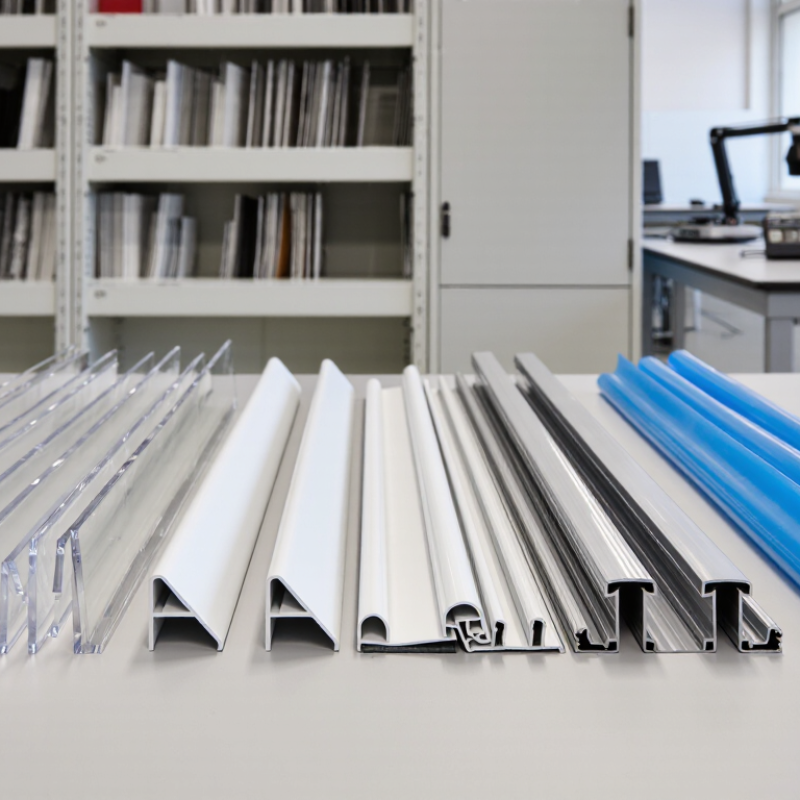
What Are Plastic Profiles and How Are They Made?
Plastic profiles are continuous shapes made from polymer materials. They include window seals, edge trims, pipes, channels, and protective rails. Unlike injection-molded parts, profiles are usually produced in long, repeatable lengths.
The process begins with plastic pellets, colorants, stabilizers, and performance additives. The selected blend enters an extruder, where rotating screws heat and mix it. The softened material then passes through a shaped metal die. The die controls the profile’s cross-section. Small design changes can affect strength, fit, and material use.
The hot profile moves through calibration tools and cooling tanks. Vacuum sizing can help maintain accurate dimensions. A haul-off unit pulls the profile at a controlled speed. Cutting equipment then produces standard lengths. Some products use co-extrusion, combining a rigid layer with a soft sealing section.
Material selection depends on the working environment. PVC may suit rigid construction components, while TPE can provide flexible sealing performance. PE and PP are often considered for chemical resistance and lower weight. However, no polymer fits every application.
Dimensional checks matter. Measure wall thickness, corner angles, surface finish, and hardness. A profile may look perfect but still twist during installation. Samples should be tested under realistic temperature, load, and moisture conditions. This step is sometimes underestimated.
Global buyers should request drawings, tolerance data, test methods, and production samples. Clear specifications reduce misunderstandings between design and manufacturing teams. Even then, a small adjustment may be necessary after trial assembly. Production is precise, but never completely automatic.
Top Types of Plastic Profiles for Global Buyers? - What Are Plastic Profiles and How Are They Made?
| Profile Type | Common Materials | Typical Manufacturing Method | Key Characteristics | Typical Applications | Buyer Considerations |
|---|---|---|---|---|---|
| Rigid Tubes and Pipes | PVC, HDPE, PP, ABS | Profile extrusion through a circular die, followed by sizing, cooling, cutting, and inspection | Lightweight, corrosion-resistant, and available in solid-wall or multi-layer constructions | Fluid handling, cable protection, drainage, irrigation, and structural assemblies | Confirm pressure rating, dimensional tolerance, wall thickness, temperature range, and applicable regional standards |
| Window and Door Profiles | uPVC, PVC, fiberglass-reinforced PVC, ASA-capped PVC | Precision extrusion, often with co-extrusion, reinforcement insertion, surface finishing, and cut-to-length processing | Good weatherability, thermal insulation potential, low maintenance, and compatibility with seals and hardware | Window frames, door frames, glazing beads, sashes, and building envelope systems | Evaluate thermal performance, UV resistance, color stability, weldability, drainage design, and hardware compatibility |
| Sealing and Gasket Profiles | EPDM, TPE, TPV, silicone, flexible PVC | Flexible extrusion using a shaped die; additional flocking, adhesive coating, cutting, or vulcanization may be used | Elastic recovery, sealing capability, resistance to moisture, and flexibility over a specified temperature range | Doors, windows, automotive assemblies, appliances, enclosures, and construction joints | Check compression set, hardness, chemical resistance, operating temperature, corner joining method, and sealing force |
| Edge Trim and U-Channels | PVC, TPE, TPU, PP, PE | Rigid, flexible, or co-extrusion processes; gripping elements may be formed into the profile | Protects exposed edges, conceals joints, and can provide impact absorption or decorative finishing | Sheet-metal edges, glass panels, furniture, vehicle interiors, machinery guards, and cabinetry | Review grip strength, installation force, bend radius, cut-end appearance, material compatibility, and profile retention |
| Decorative and Finishing Profiles | PVC, ABS, PMMA, PS, PP | Extrusion with embossing, printing, laminating, co-extrusion, or decorative film application | Provides visual finishing, joint coverage, color consistency, and protection against abrasion or moisture | Furniture, flooring, wall panels, ceilings, retail fixtures, and interior decoration | Specify color tolerances, gloss level, surface texture, scratch resistance, bendability, and batch-to-batch consistency |
| Cable Management Profiles | PVC, PP, PE, TPE, flame-retardant compounds | Extrusion, co-extrusion, or post-forming; adhesive backing and perforation can be added | Organizes and protects cables while offering electrical insulation and flexible routing options | Electrical panels, office furniture, machinery, data installations, and consumer equipment | Assess flame behavior, dielectric properties, bend radius, adhesive performance, cable capacity, and installation environment |
| Structural and Support Profiles | PVC, HDPE, PP, polycarbonate, glass-fiber-reinforced thermoplastics | Profile extrusion, often followed by reinforcement, drilling, machining, or assembly into modular systems | Low density, corrosion resistance, electrical insulation, and customizable cross-sectional geometry | Signage, greenhouse systems, partitions, equipment frames, supports, and protective structures | Verify load requirements, creep behavior, flexural strength, UV exposure, fastening method, and dimensional stability |
| Medical and Laboratory Profiles | Medical-grade PVC, TPU, silicone, polyethylene, polycarbonate | Controlled extrusion with validated material handling, dimensional inspection, cleaning, and packaging procedures | Can be designed for transparency, flexibility, chemical resistance, and controlled fluid or air pathways | Fluid lines, laboratory equipment, protective channels, medical devices, and diagnostic systems | Confirm biocompatibility requirements, sterilization compatibility, extractables, traceability, cleanliness, and regulatory documentation |
| Transparent and Light-Diffusing Profiles | Polycarbonate, PMMA, PETG, transparent PVC | Precision extrusion with polished or textured tooling; co-extruded caps and diffusing layers may be added | Light transmission, impact resistance, visual clarity, or controlled light diffusion depending on the formulation | Lighting channels, displays, protective covers, glazing components, and equipment guards | Specify optical clarity, haze, yellowing resistance, impact performance, surface quality, and allowable dimensional variation |
Related Posts
-

How to Choose the Right Plastic Profiles for Your Project?
-
Why Choose Plastic Profiles for Global Sourcing?
-
Top 10 Plastic Extrusion Profiles You Need to Know?
-
Innovative Plastic Profiles Shaping the Future of Construction and Design with 30 Percent Increased Durability
-

2026 How to Choose and Use Plastic Profiles Effectively?
-

Top 10 Uses of Plastic Extrusion Profiles in Modern Industries?